
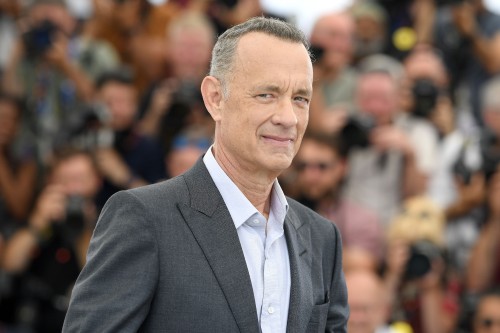
Tom Hanks is one of the most well-known American stars in the world. And he is perhaps the kindest and most conscientious person in Hollywood. So why would anyone want to prevent him from being recognized for his talents and finer qualities?
It was all set last month that Tom Hanks was to receive the prestigious Sylvanus Thayer Award from the West Point Association of Graduates on September 25, 2025. This award is one of the highest civilian honors associated with the United States Military Academy and is given to individuals whose lives exemplify the academy’s values —Duty, Honor, Country.
Tom Hanks may not wear a uniform, but his work has consistently honored those who do. His body of work includes three major military-themed films: Saving Private Ryan, Band of Brothers, and Apollo 13. Each of these projects has been praised by veterans and historians alike for its emotional authenticity and historical accuracy, helping to preserve the legacy of American service members for generations to come. And in recognition of his personal contributions to American culture and civic life, he was awarded the Presidential Medal of Freedom by President Barack Obama, who praised Hanks as someone who has always been “a good guy.”
It was surprising when retired Army Colonel Mark Bieger, President and CEO of the West Point Association of Graduates, announced the cancellation of the ceremony to honor Tom Hanks—a decision that came just weeks before the scheduled event and without a clear explanation. In an internal message, Bieger stated, “This decision allows the Academy to continue its focus on its core mission of preparing cadets to lead, fight, and win as officers in the world’s most lethal force, the United States Army.” Hanks had accepted the award and ceremonial preparations were underway, making the reversal all the more abrupt. With no further reasons given, speculation quickly grew that the cancellation may have been politically motivated.
Donald Trump confirmed this general suspicion when he personally applauded the cancellation with posts on Truth Social on September 8, 2025, “Our great West Point (getting greater all the time!) has smartly cancelled the Award Ceremony for actor Tom Hanks. Important move!” and “We don’t need destructive, WOKE recipients getting our cherished American Awards!!! Hopefully the Academy Awards, and other Fake Award Shows, will review their Standards and Practices in the name of Fairness and Justice.” With those remarks, Trump not only denied Hanks this public honor — he weaponized the moment. By labeling Hanks “WOKE,” Trump made clear that he views the actor’s public advocacy—on issues like racial justice, historical truth, and civic responsibility—as incompatible with the values Trump believes should define military honors.
It’s worth noting that the term “WOKE” has evolved significantly over time. Originally rooted in African American cultural expression, it referred to a heightened awareness of social injustice and systemic inequality. Over the past decade, however, it has been repurposed by political commentators to describe progressive activism, cultural sensitivity, or some sort of perceived moral posturing. In today’s polarized climate, calling someone “WOKE” can be a either a badge of honor or a political insult, depending on who’s speaking. Despite its contested usage, the spirit of WOKE—awareness, empathy, and justice—remains deeply meaningful to many.
So is Tom Hanks too WOKE? That depends entirely on how the term is defined. If “WOKE” means being aware of injustice, advocating for truth, and using one’s platform to elevate stories of courage and sacrifice—then Tom Hanks certainly embodies that spirit. His work consistently reflects empathy, historical awareness, and a desire to uplift the human experience. In contrast, Donald Trump often uses the term “WOKE” as a critique of cultural shifts which he views as excessive or divisive. These two figures represent fundamentally different approaches to public life: one seeks to unify through understanding, the other to galvanize through disruption. In this light, the question of being “too WOKE” becomes less about ideology and more about intention.

   #16 MON CAN Tom Hanks 7/9/1956 |
It has been our practice to present the Dayology Signature of the individual or individuals being examined in this spot. After eight years of examining these 84 Day Ray / Sun Sign combinations, we’ve decided to take the next step – showing how the Dayology Signatures work within the full context of Natal Horoscopes. While the many complexities of traditional astrology may take time to absorb, Dayology offers a meaningful starting point for all those drawn to the Starry Art.
Tom Hanks was born on a Monday which is ruled by the Moon. This day-of-the-week influence adds a extra layer of emotional depth and intuitive sensitivity to his Cancer Sun. The Moon’s transition from Cancer to Leo on the day of his birth suggests a dynamic shift in emotional expression—from inwardly nurturing to outwardly creative. This movement into the 11th House, the domain of friendships, ideals, and collective aspirations, indicates an ability to widely connect with audiences and portray characters that resonate with the human experience.
Both Monday and Cancer are ruled by the Moon, giving his INNER and OUTER Selves the same Ruler. A Double Moon Signature Ruler inclines one to the feeling side of life, regardless of any other gifts that the natal chart might bestow on him. This lunar doubling allows him to sense what others need—perhaps even before they know it themselves. Such a situation creates a natural emotional resonance, allowing him to embody roles with a sincerity that feels both intimate and universal. It gives him that “touch” that brings his film portrayals alive.
It is the astrological relationship between the Day Ray and Sun Sign creates each distinctive Dayology signature dynamic. In this case the rulers of #16 SUN CAN are in mutual reception, which is a extremely significant astrological signal. The Sun is in Cancer and the Moon is Leo. —each luminary occupying the sign ruled by the other. This condition, known as “being in the sign of the other,” forms a rare energetic loop that enhances cooperation between the INNER and OUTER Selves. It’s as if his emotional instincts and conscious will are working in tandem.
One other important thing that must be mentioned is the fact that Tom Hank’s Cancer Sun in the 10th house tops a grand water trine with a Scorpio Saturn in the 3rd House and a Pisces Mars in the 6th House. This flowing configuration links the emotional depth of Cancer, the psychological insight of Scorpio, and the compassionate drive of Pisces into a seamless circuit of instinctive wisdom. This trine is not just a gift—it’s a spiritual engine that fuels his ability to move hearts, shape narratives, and serve something greater through his performance art.
So, is Tom Hanks too WOKE? The natal chart of Tom Hanks affirms that he is a spiritual being living a human life in full view of the world. His WOKE is not a posture—it’s a presence. It is absolutely perfect. He is exactly what he was intended to be: nothing less, nothing more.
View the Natal Chart of Tom Hanks
close up and personal
on AstroDataBank


